
Deodar Cedar
Researched by Jordyn Brown
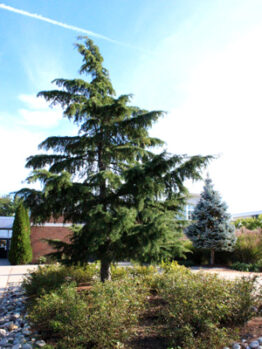 Species: Cedrus deodara
Common name: Deodar Cedar, Deodar, Himalayan Cedar
Family: Pinaceae
Clade: Gymnosperm
Coordinates: 39.7139031, -75.1189936

A tag using this number is placed near the tree.
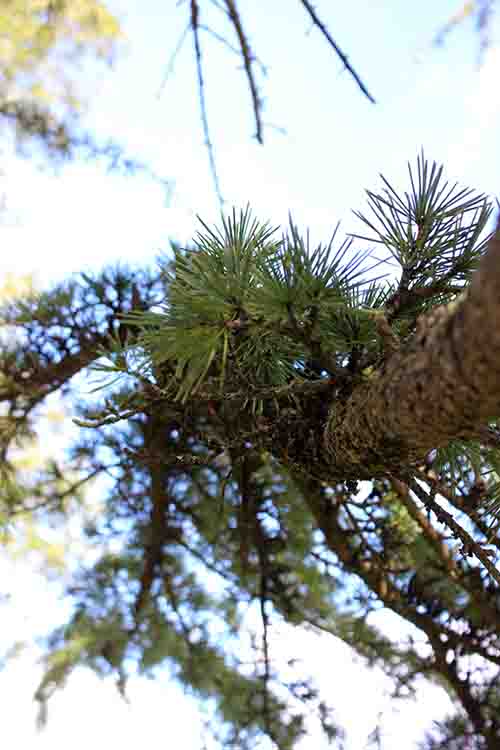
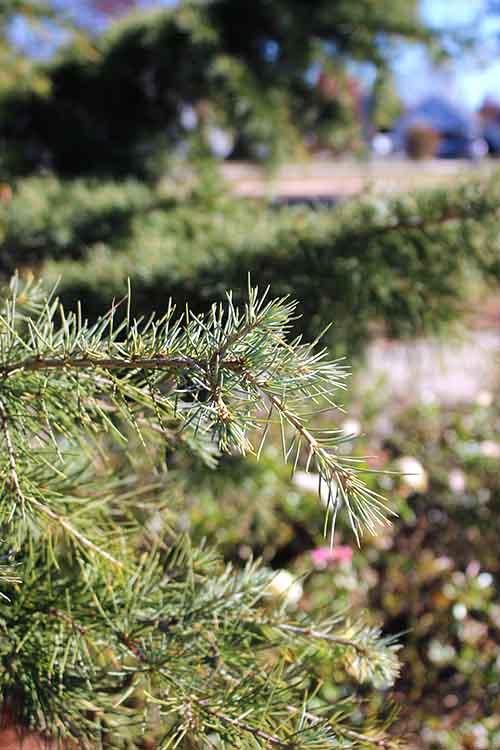
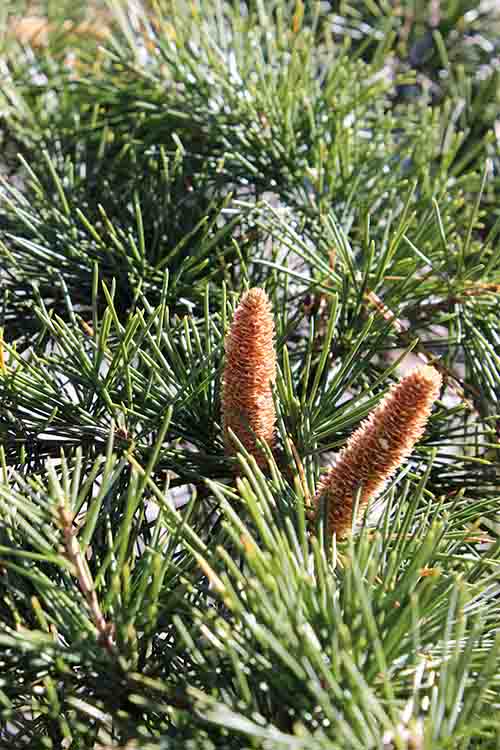
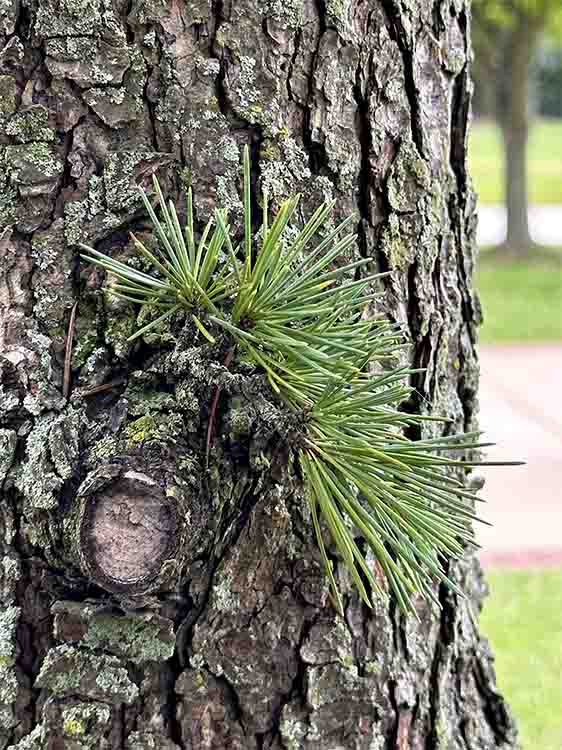
Deodar cedar, or Cedrus deodara, is an ornamental tree native to the forests of the Western Himalayas. It grows across parts of Asia, including Afghanistan, India, and Nepal, and is Pakistan’s national tree. This towering specimen can grow up to 250 feet. Some consider it divine and sometimes refer to it as the “tree of gods.” Deodar cedars are evergreen, meaning they retain needles through all seasons, and they do not change color. Needles grow to a sharp point and are patterned on the branches differently: needles on the tops of branches grow singly, while on the sides, they develop in densely whorled clusters of 15 to 30 spurs. Depending on the variety and cultivar, deodar cedar can produce needles of green, grayish green, blue-green, and even bright yellow.
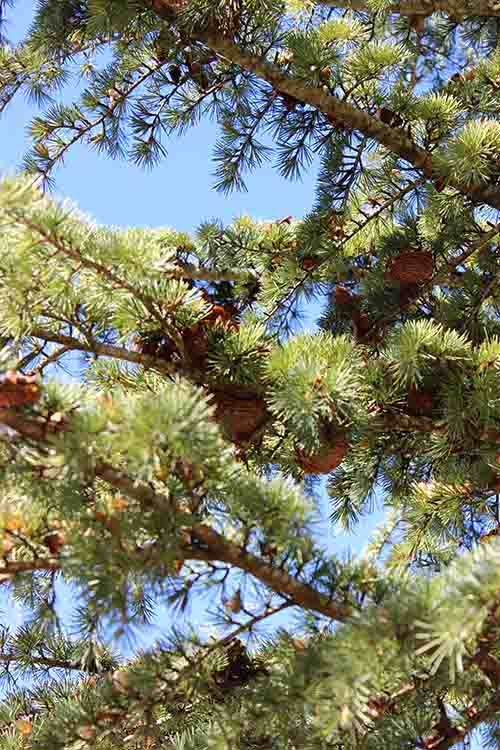
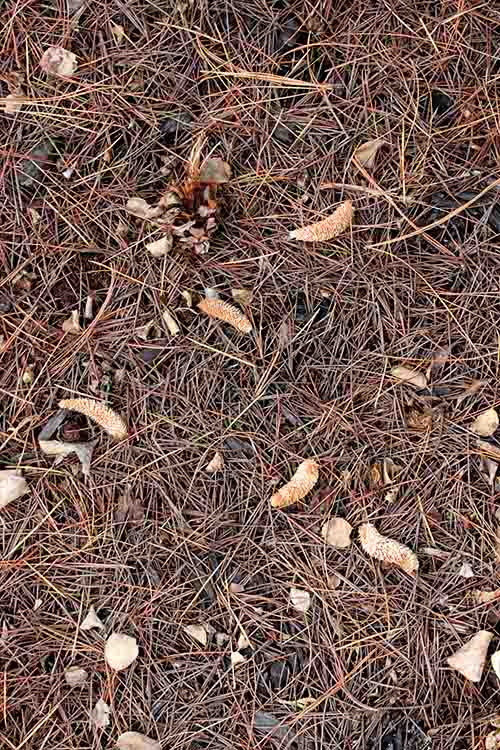
Deodar cedars are monoecious, meaning they have both male and female cones. These cones turn from light green or teal to brown or purple-brown in the fall. Male and female cones are discernable by their shape: female cones tend to be more barrel-shaped, whereas male cones tend to be oval and oblong. From October to November, the male cones release pollen, which is dispersed by the wind. After dispersing pollen, the cones fall from their branches. Ovules within the female cones are wind-pollinated and fertilized. After two years of seed development, the mature female cones break down, and their winged seeds disperse. Read More






Campus Species Map
Researcher’s Biography

Jordyn Brown
Jordyn Brown earned a Bachelor of Science degree in Biological Sciences in 2024.
Suggested Citation:
Brown, Jordyn. (2023, Dec). Deodar Cedar. Rowan University Arboretum. https://arboretum.rowan.edu/trees/deodar-cedar/
Questions to Explore
- How fast does Cedrus deodara grow, and what is its life expectancy?
- How can Cedrus deodara be used in garden design and landscaping?
- How does the deodar cedar differ in appearance from other cedar trees, and why?
- Who is credited to be the first person to describe the Cedrus genus, and when?
- How has the Deodar cedar been used medicinally, and what research is currently being explored?
References
Bisht, A., Jain, S., Misra, A., Dwivedi, J., Paliwal, S., & Sharma, S. (2021). Cedrus deodara (Roxb. ex D.Don) G.Don: A review of traditional use, phytochemical composition and pharmacology. Journal of Ethnopharmacology; 279, 114361. | Link
Coombes, A.J. (2002). Smithsonian Handbooks: Trees. Dorling Kindersley, Inc.
Everett, T. H. (1980). The New York Botanical Garden illustrated encyclopedia of horticulture. Garland Publishing, Inc.
Farjon, A. (2013). IUCN Red List of Threatened Species: Cedrus deodara. The IUCN Red List of Threatened Species. | Link
Gilman, E.F., & Watson, D.G. (2014). ENH293 Cedrus deodara: Deodar Cedar. University of Florida IFAS Extension. | Link
Gupta, S., Walia, A., & Malan, R. (2011). Phytochemistry and pharmacology of Cedrus deodera: An overview. International Journal of Pharmaceutical Sciences and Research, 2(8). | Link
Kumar, S., Gupta, R., Joshi, R. K., & Garkoti, S. C. (2023). Rhizosphere soil properties and microbial biomass changes with the chronosequence of stand age of broadleaf banj oak and coniferous deodar forests in the central Himalaya, India. Rhizosphere, 27, 100761. | Link
Kumar, S., Kumar, A., Pradesh, H., Kumar, I. R., Kumar, S., Kumar, A., & Kumar, R. (2019). Himalayan (Himachal region) cedar wood (Cedrus deodara: Pinaceae) essential oil, its processing, ingredients and uses: A review. Journal of Pharmacognosy and Phytochemistry, 8(1): 2228-2238.
More, D., & White, J. (2002). The illustrated encyclopedia of trees. Timber Press.
Niemiera, A. X. (2018). Cedars, Cedrus spp. Virginia Cooperative Extension. | Link
North Carolina State University. (n.d.). Cedrus deodara (Deodar Cedar, Himalayan Cedar). North Carolina Extension Gardener Plant Toolbox. | Link
Qiao, C., Ran, J., Li, Y., & Wang, X. (2007). Phylogeny and Biogeography of Cedrus (Pinaceae) Inferred from Sequences of Seven Paternal Chloroplast and Maternal Mitochondrial DNA Regions. Annals of Botany, 100(3), 573-580. | Link
Salazar Mendi?as, C., & Guerrero Ruiz, F. J. (2013). Flora ornamental de la Universidad de Jae?n: Campus de Las Lagunillas. Universidad de Jae?n.
Sharma, C. M., Baduni, N. P., Gairola, S., Ghildiyal, S. K., & Suyal, S. (2010). Tree diversity and carbon stocks of some major forest types of Garhwal Himalaya, India. Forest Ecology and Management, 260(12), 2170-2179. | Link
United States Department of Agriculture (USDA). (2008). The Woody Plant Seed Manual. Agriculture Handbook 727. | Link
United States Department of Agriculture (USDA) Agricultural Research Service. (2023). Cedrus deodara (Roxb. ex D. Don) G. Don GRIN-Global. National Plant Germplasm System. | Link
University of Arizona. (2012). Cedrus deodara. University of Arizona Campus Arboretum. | Link
Utah State University. Cedar, Deodar. Tree Browser USU Extension. | Link
Wen, Z., Lin, C., Xu, X., Ma, S., Peng, Y., Sun, Y., Tang, B., & Shi, L. (2023). Ectomycorrhizal community associated with Cedrus deodara in four urban forests of Nantong in East China. Frontiers in Plant Science, 14, 1226720. | Link